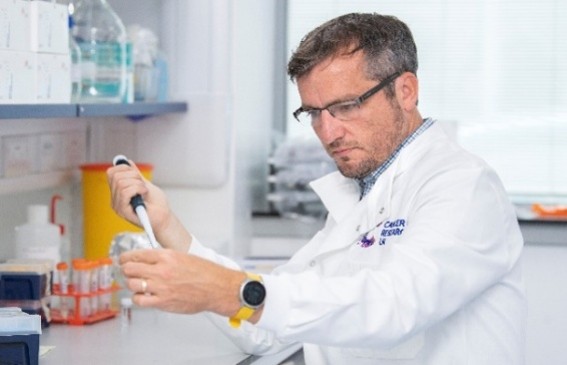
Professor Adrian Saurin established his lab in Dundee in 2013 using support from the Ninewells Cancer Campaign. Below you can find out about his research journey and the impact it is having on Dundee and the wider cancer research community.
Understanding how cancers progress and become resistant to therapy
My group studies how cells in our bodies divide, and why this process so often goes wrong in cancer. When it goes wrong, tumours can become resistant to treatments like chemotherapy or radiotherapy. In the movie example below, you can see duplicated chromosomes (packages of DNA, shown in white) being separated into two new daughter cells. This is vital so each new cell keeps the same set of genetic instructions.
It’s staggering to think that there are about 20 trillion cell division events every year inside our bodies, just to replace old tissue and keep us alive. Most of the time this is amazingly accurate. That’s important because if cells end up with the wrong amount of DNA, they can gradually become genetically different from each other, and cancers can form.
In fact, almost all cancers struggle to separate their chromosomes properly when they divide. Yet we still don’t fully understand why. This matters because it makes cancer harder to treat. After many faulty divisions, tumours become a mixed collection of genetically different cells each with different properties. The problem is the chance that at least one of these cells has the right genetic combination to survive chemotherapy or radiotherapy then becomes much higher.
My group studies the inner workings of cell division to learn why it fails so often in cancer cells, with the aim of using that knowledge to find new ways to treat cancer. One new area I’m especially excited about is a method we recently set up to analyse cell division in a completely new way.
When a cell divides it must switch signals (chemical messages) on and off, rather like a light. There are billions of these ‘lights’ inside our cells. Over the last few decades, scientists have learned a huge amount by taking ‘photographs’ (single time-points) to see which lights are on or off at any given moment.
That approach is powerful, but it can miss important changes in a fast-moving process like cell division, when a lot changes from one minute to the next. So, we have set up a method that will allow us, for the first time, to take ‘movies’ of these signals and see how they behave over time. We think this will reveal new information about how cell division works, and that may ultimately help explain why it goes wrong so often in cancer.
I am very grateful that the Wellcome Trust has pledged £4M to support this project over the next 8 years. (Press release link to be inserted.)
Finding new ways to treat breast cancer more effectively
As well as investigating why cancer cells divide incorrectly, we are also searching for new ways to stop them dividing for good, so we can treat cancer more effectively. One of the biggest success stories in recent years has been CDK4/6 inhibitors, which are drugs that block a key ‘go-ahead’ signal for cell division.
These drugs have transformed treatment for the most common subtype of metastatic breast cancer: hormone receptor positive breast cancer, which accounts for around 70% of cases. On average, CDK4/6 inhibitors can keep the disease under control for about twice as long as was typical just a few years ago. However, we still need to go further because many tumours that initially respond eventually become resistant to the drug. Our lab recently made discoveries that could help explain why this happens.
CDK4/6 inhibitors were known to stop tumour growth by putting cancer cells into a state called senescence (a permanent stop to cell division). Senescent cancer cells then stop dividing and are often removed by the immune system.
We discovered why cells enter senescence after drug treatment, something that was not previously understood. When we treated cancer cells with these drugs, the cells grew in size, becoming 4–5 times larger than normal after just one week (see example images below). We found that this ‘overgrowth’ pushes cells into senescence, so they stop dividing permanently, even when the drug is removed. This could help explain why these drugs can have long-lasting effects in the clinic.
Fundamental discoveries like this can often reveal things that are unexpected. In our case, we found that senescent cells can become very dangerous if they start dividing again (for example, if they are not cleared by the immune system).
When we filmed these enlarged cells and then removed the drugs, many failed to divide, but the ones that did often made a large number of mistakes, even more than typical cancer cells. That means they can become genetically different very quickly.
This may help explain why so-called ‘zombie’ cells (senescent cells that restart division) are so dangerous – a point supported by many animal studies from other groups. Our idea is that the large size of these zombie cells may allow them to change their genetic makeup quickly, which could make drug resistance emerge faster.
In the lab, we have been able to track resistant cells appearing under the microscope after treatment. The big question is whether this also happens in patient tumours and, if so, how we might use what we’ve learned to delay or prevent drug resistance or relapse.
We’re very excited to answer these questions over the coming years using funding from Cancer Research UK, who have pledged £1.3M to support this work over the next 5 years. (Press release link to be inserted).
The importance of Ninewells Cancer Campaign support
I am incredibly grateful to the Ninewells Cancer Campaign. It is hard for me to put into words just how important their funding has been to me at all stages of my career. Their support allowed me to buy essential equipment when I started my lab, and they funded my first PhD student.
That early support helped to generate the data that underpinned my first £1.3M grant from Cancer Research UK in 2015. More recently, Ninewells Cancer Campaign funded a second PhD student in 2021 (Aanchal Pareri), who made the discovery that cells that rewaken from senescence can drive CDK4/6 inhibitor resistance.
These findings were crucial in helping me secure a second major £1.3M grant from Cancer Research UK, which is due to start in August 2026. Together this shows how relatively small, targeted local funds can support important research breakthroughs, and can also help unlock much larger awards from national funders.
Building on these larger awards, we can also work towards something even bigger at the University. For example, I was one of the founding members of a new Department of Genome Integrity at the University of Dundee in late 2025. This was formed by four research groups led by staff from the Faculties of Health (Saurin) and Life Sciences (Labib, Rouse, Alabert).
We have already recruited another group from London (Bertolin), and we plan to recruit more over the coming years to establish Dundee as a world-leading centre for research into genome replication, repair and division – major processes that often fail during cancer progression.
As evidence of Dundee’s expertise in this area, The Wellcome Trust have recently invested a total of £10M to support three of the groups in our new department over the next 8 years.
Communicating science effectively
If you’d like to learn more about my lab and our research, you can visit my website at www.saurinlab.com. There you’ll find short videos and podcasts explaining our work in simple terms.
I am passionate about making science accessible to the public, and about helping people understand how healthy lifestyle choices can reduce cancer risk. That’s why we created a computer game to explain cancer to younger audiences, which you can find at www.saurinlab.com/play.
It’s important to emphasise that lifestyle choices don’t just matter for cancer prevention – they can also affect outcomes after a cancer diagnosis. Exercise, for example, can bring benefits that are comparable to a ‘wonder drug’ in terms of improving treatment responses, even when started after diagnosis.
We don’t yet know all the details of why exercise is so beneficial, but the leading idea is that it can prime the immune system to become better at detecting and fighting cancer from within. So even small amounts of carefully planned exercise during treatment may help many people.
My wife has recently come through one year of treatment for stage III breast cancer, and she did this while taking up regular exercise routines during and after treatment. I like to think of exercise as a ‘zombie killer’: a way to help activate the immune system to remove any remaining rogue senescent cancer cells that could otherwise become dangerous.
It’s becoming increasingly clear that the immune system is one of the best tools we have to fight and cure cancer. We still need to learn how to harness it most effectively, but exercise may be one simple and practical way to help in a wide range of settings.